The Immortality Trap
 Teddy Warner
| Dec 2025
| 9–11 mins
Teddy Warner
| Dec 2025
| 9–11 mins

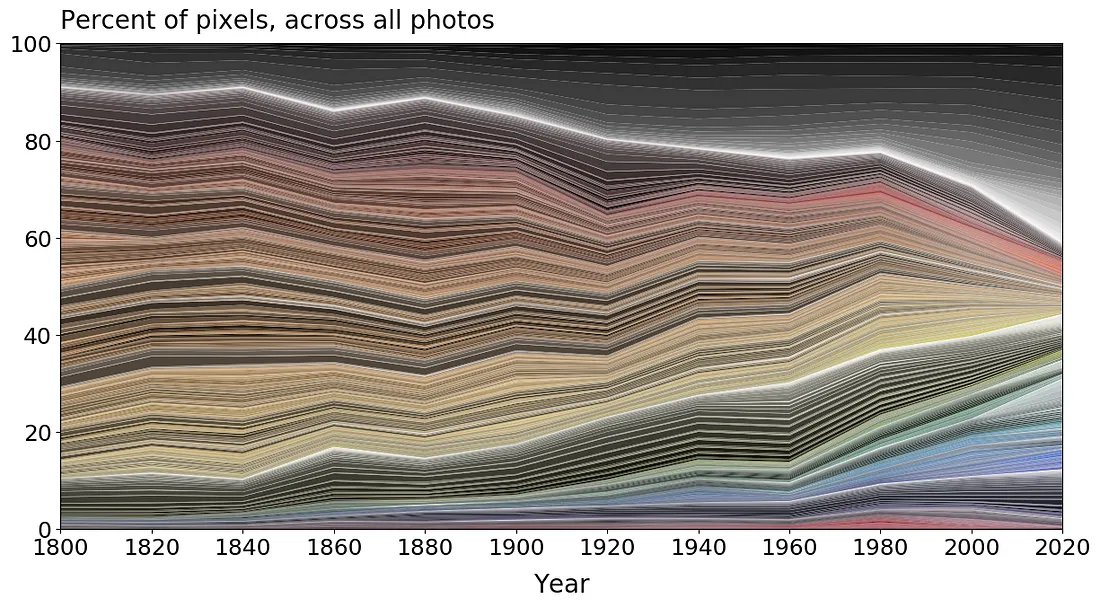
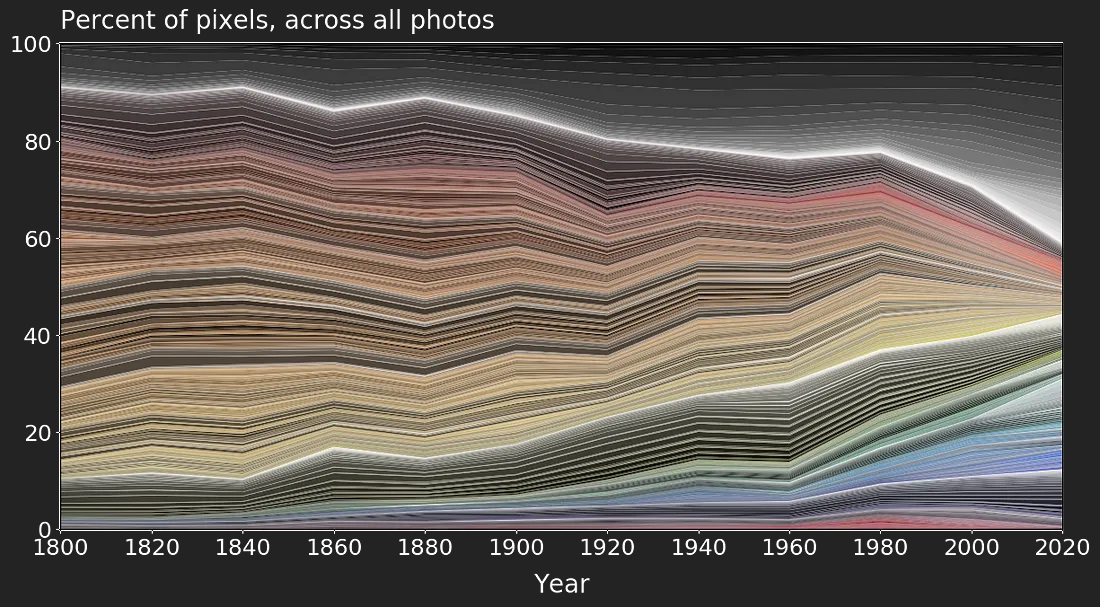
This morning a friend sent me an intresting read: The Decline of Deviance an aggregate of data showing a massive collapse in risk-taking behavior over the past few decade. Teen alcohol use down 50%. Sexual activity down 40%. Fighting down 35%. Geographic mobility collapsed from 20% of Americans moving annually to 10%. Even our aesthetics became safer, British Museums analyzed photos of their artifacts over time and found a steady shift toward black, gray, and white, away from bold colors. Seemingly, we’ve entered an “epidemic of the mundane”.Adam Mastroianni, The Decline of Deviance — documenting the collapse in risk-taking behavior from 1990–2024.
Changes in the color of objects over time
At the time of writing this piece, I’m 20 years old. According to the Social Security Administration, my average life expectancy is 81.6, meaning I have roughly 61 years left on this planet.SSA Period Life Table — life expectancy for 20-year-old males: 81.6 years.
Every time I get in a car to go somewhere, I run about a 1 in 8.3 million chance of death.NHTSA reports 1.20 deaths per 100M vehicle miles in 2024. At ~10 miles per trip: 1 in 8.3 million. Every time I sit down to eat, about a 1 in 147 million chance of choking.~2,500 food-related choking deaths/year (CDC) across ~367 billion annual meals: 1 in 147 million per meal. Every walk I take, roughly 1 in 5.5 million.~7,148 pedestrian deaths in 2024 (GHSA) across ~39 billion walking trips: 1 in 5.5 million per walk. Every time I take up a simple convience, I wager the remaining 61 years of my life for said convience (i.e. I’m essentially wagering 61 years at 1:8.3M odds every time I drive).
Let’s conceive of a world of pragmatic ‘immortality’, one where the average lifespan is 1000 years. Our wager of years of life in exchange for convience still occurs, except in this world I’d be wagering 980 years for those same conveniences. The stakes increase 16 fold while the benefits remain near identical!
To state this precisely: the average drive is about 10 miles, that’s currently about 4 minutes of expected life loss per trip. With a 1000-year lifespan, that same trip costs 62 minutes of expected life. The wager is 15.8x larger.Expected life loss per trip = years at stake × death probability × distance. At 61 years remaining: ~3.9 min/trip. At 980 years remaining: ~61.9 min/trip. A 15.8× larger wager.
So what happens if we achieve our sought after ‘immortality’? Say we cure aging, dampen disease, and successfully extend the human lifespan to ~1000 years. The transhumanist dream.
I conjecture our lives would be no better than they are now.
But Teddy! Surely, by the time we have 1000-year lifespans, we’ll have much safer technology. And you would be right to claim this, the fatal risk associated with any given acction will continus to decline!
Between 1900 and 2024, life expectancy jumped 68%, from 47 to 79 years.CDC NCHS — 47.3 years in 1900 to 79.25 in 2024, a 68% increase. During the same period, transportation got dramatically safer and faster. Traffic deaths dropped from ~18 per 100 million miles in the 1920s to 1.20 today, a 15x improvement.NSC Historical Data — 18.65 deaths per 100M VMT in the 1920s. NHTSA 2024 — 1.20 deaths. A 15.5× improvement. Average speeds increased from 8 mph (stagecoach) to 45 mph (cars), roughly 5.6x faster.
Life expectancy vs transportation speed 1900-2024
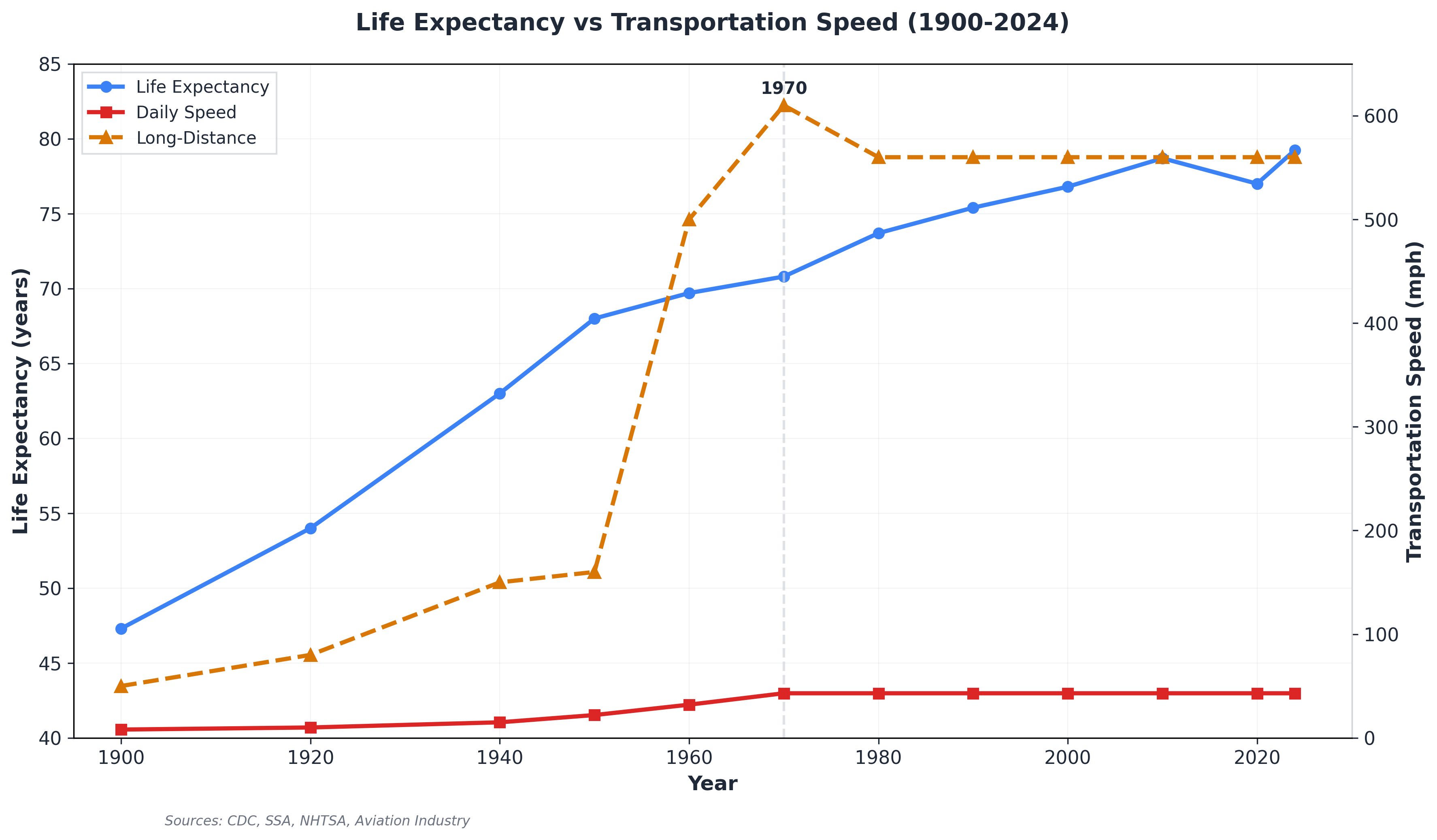
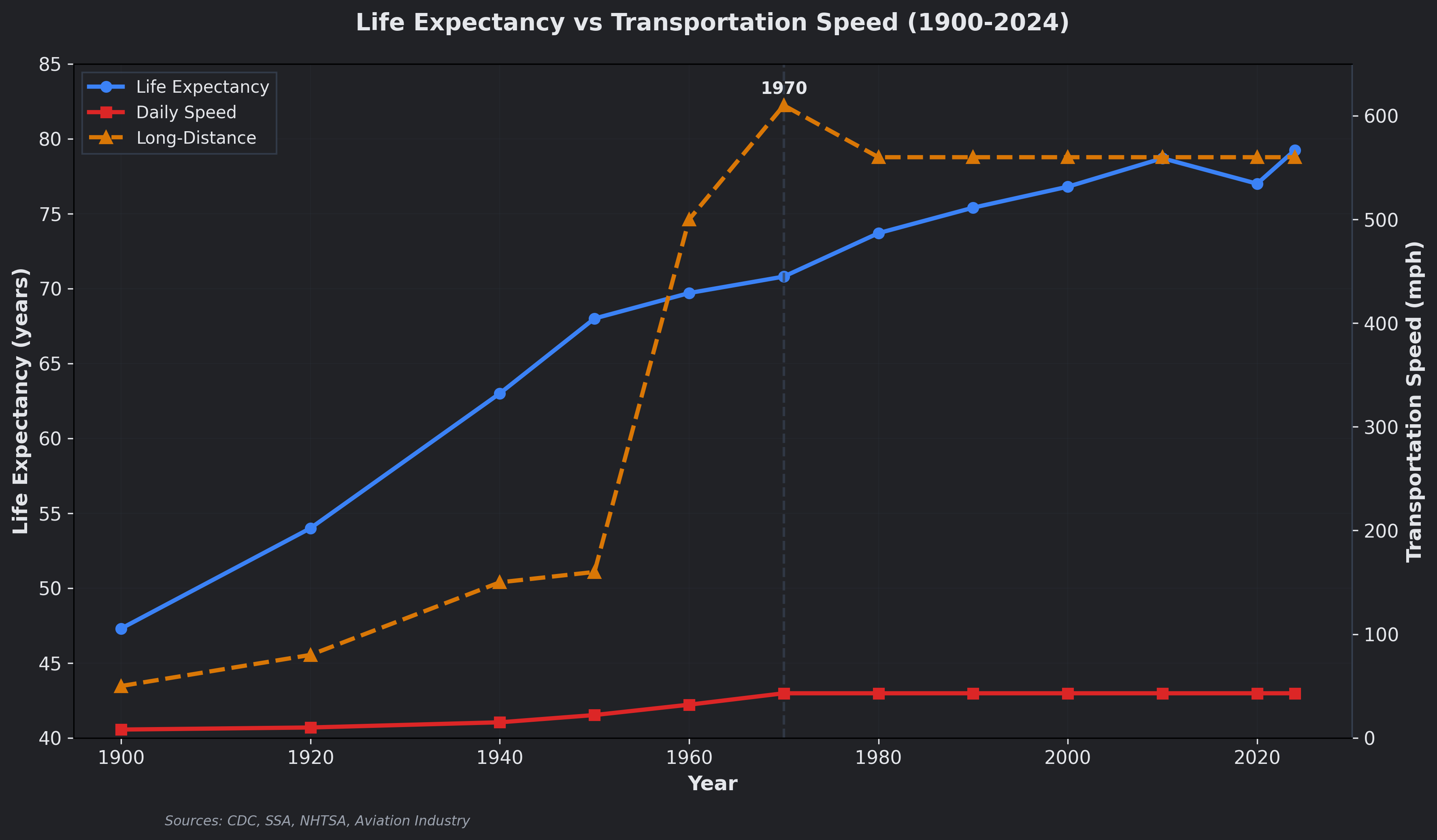
For most of the last century, technological safety and speed massively outpaced our lifespan. Risk per trip decreased 110x while stakes only increased 1.3x. Subjectively, travel got safer despite having more years of life at risk.
Yet, unfortunately, this trend tapered off towards the end of the 20th century. Since 1970, transportation speeds have stagnated or declined. The Boeing 747 (1970) cruised at ~600 mph. The Boeing 787 (2024)? only ~560 mph. We had supersonic passenger flight with the Concorde at 1,350 mph - we abandoned it in 2003. US highway speeds have been stuck at 55-75 mph for fifty years. Meanwhile, mean life expectancy kept climbing, with about a 12% increase (from 70.8 to 79.2 years).
I find the Concorde’s retirement to reveal something profound: people with longer lives value safety over speed. They’d rather fly 7 hours at 560 mph than 3.5 hours at 1,350 mph if the crash rate is marginally higher. With 1000-year lifespans and those same risk ratios, would anyone fly at all?
Or look at playgrounds - I grew up playing in this massive wooden playground in the Chicago suburbs, with a somewhat ever-present risk of injury.Indian Boundary Park — built in 1989 by neighborhood volunteers. Today, it is illegal to build a sandbox in a playground in San Francisco.SF Chronicle — SF banned sandboxes due to bacterial contamination concerns. As our life expectancy rises, it makes more sense to optimize toys and playgrounds for preventing lawsuits rather than developing children who know how to manage risk.
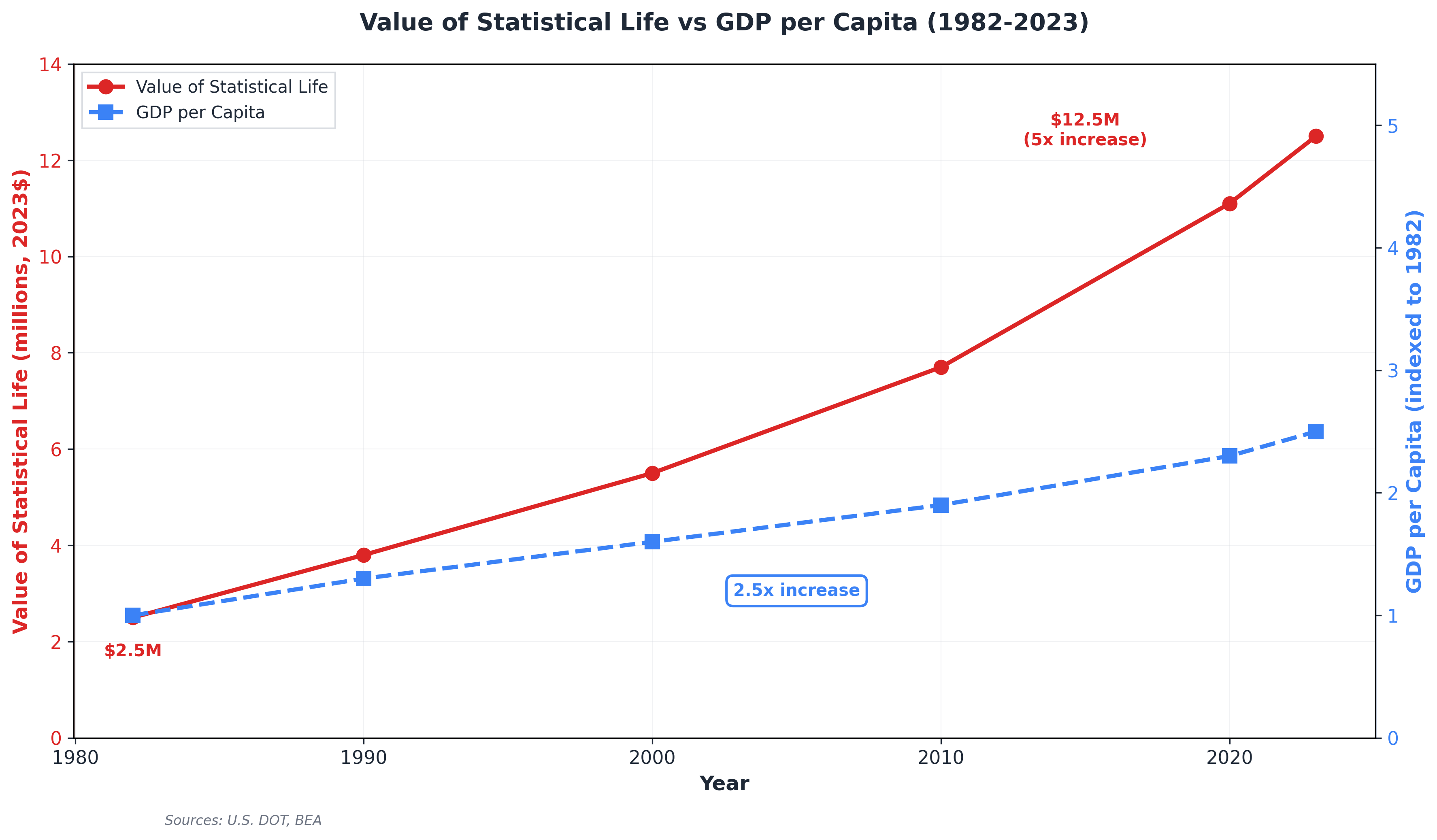
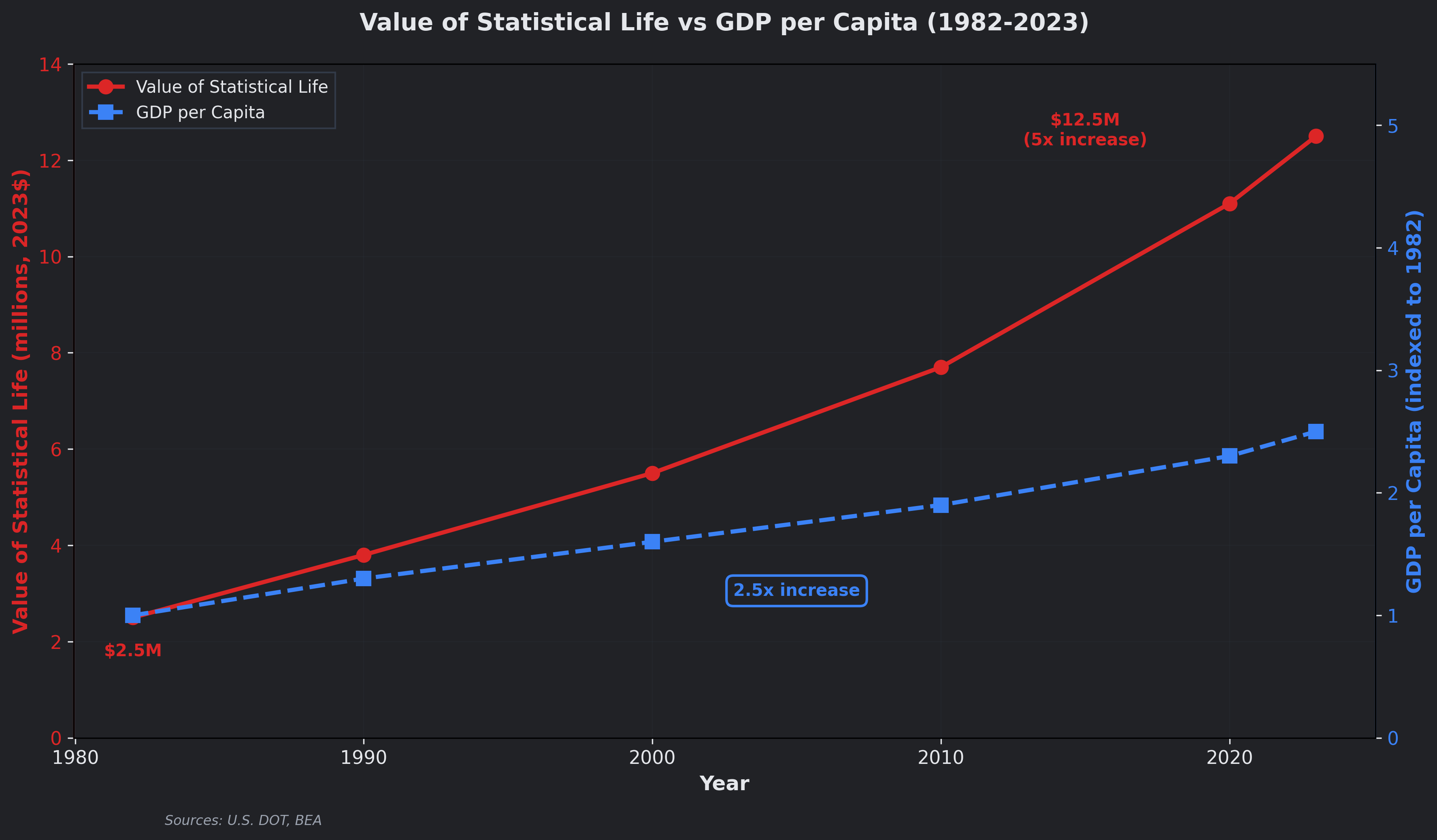
Our modest (~12%) lifespan increase since the end of the last century has already caused massive behavioral changes. The value of statistical life has jumped from $2.5M in 1982 to $12.5M in 2023 (inflation-adjusted).DOT VSL Guidance — $2.5M in 1982 to $12.5M in 2023 (inflation-adjusted), a 5× increase. That’s a 5x increase in what society would ‘pay’ to prevent one death, while GDP per capita only grew 2.5x (so clearly wealth alone isn’t our driving motivator).
Value of statistical life 1982-2023
If we try extrapolating this out over even the next 500 years, we can assume a near-complete eridication of risk. Not necessary because people are conscious of this, but rather because the expected value of any convience shifts dramatically. If people’s base state is one of higher comfort, they have substantially more time to do things, and doing any rapid convienent thing is wasting this additional time, of course, society becomes sluggish!
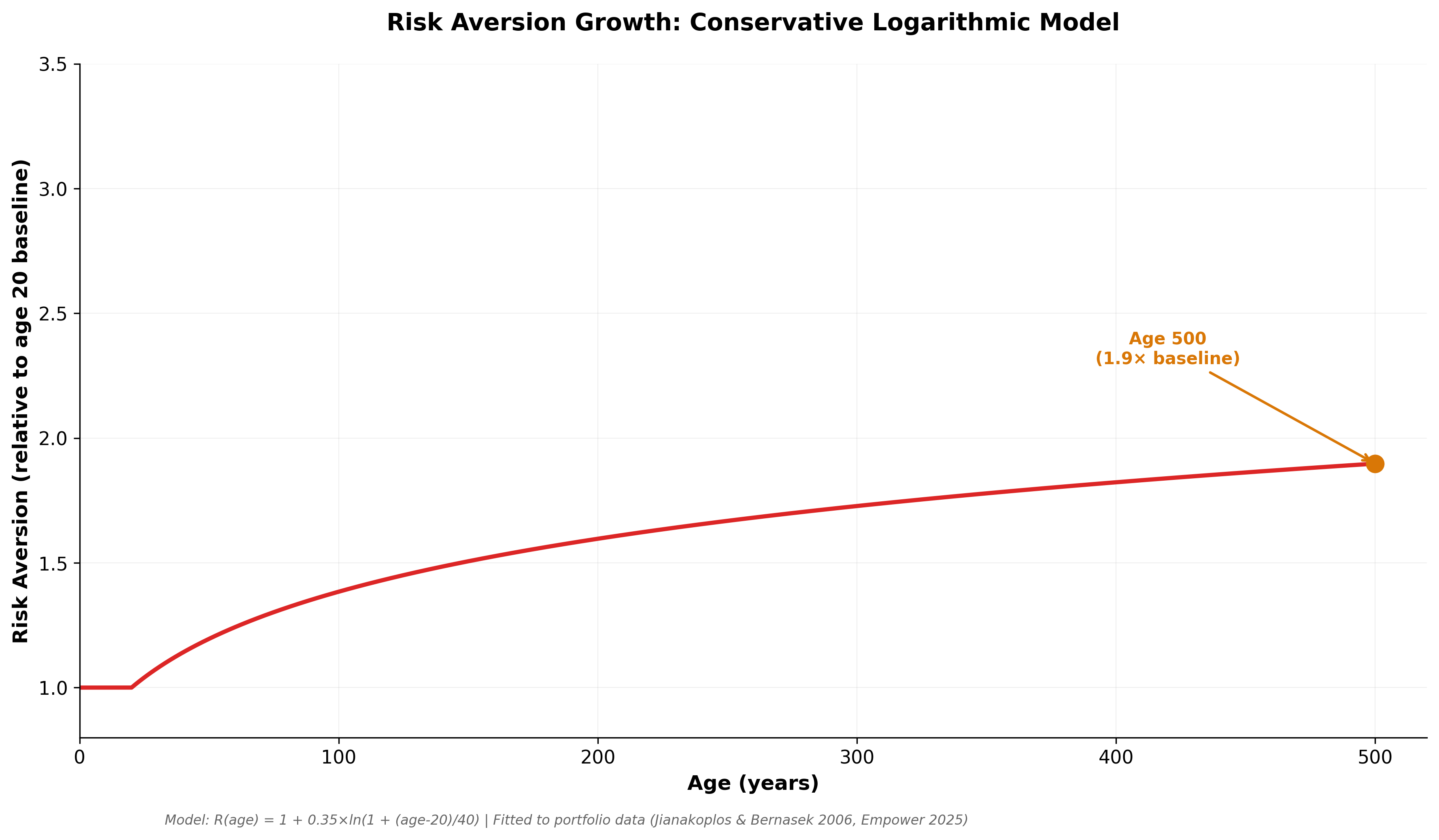
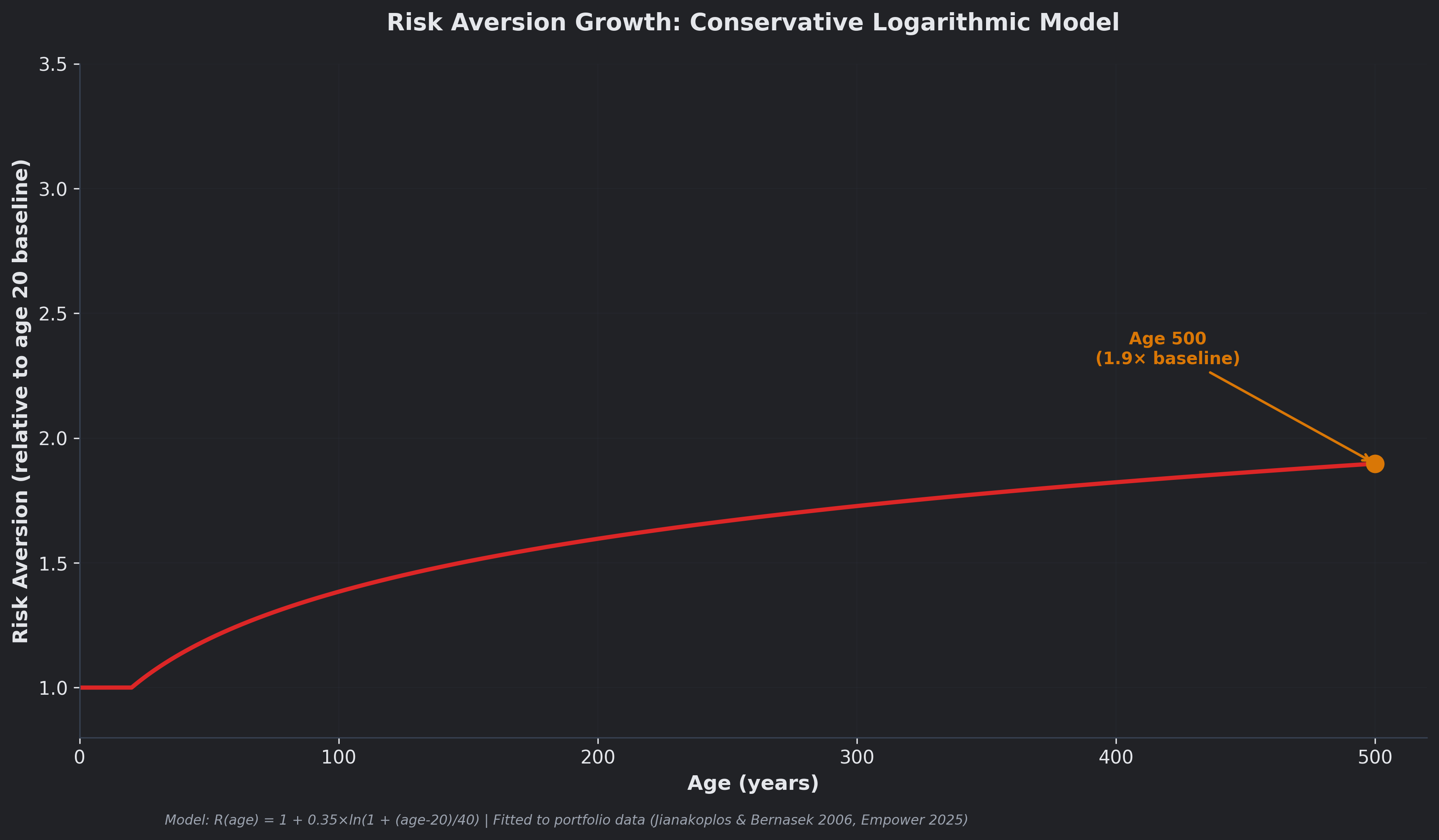
This derisking problem compounds even further when we consider that risk aversion grows with age. How much longer will a parent “baby” their child in a society of 1000-year lifespans? The age of those setting the behavioral norms will continously shift higher and hider, and society will become more and more risk adverse. In a society with 1000 year lifespans, the median person (presumably the cohort of people setting behavioral precidant) would be 500 years old. If risk adversion continues growing with age at the rate observed in current populations (roughly 1.5% per year of age), a 500 year old would be about 8.5x more risk-averse than the average 20 year old today.Jianakoplos & Bernasek (2006) found risky asset ratios decline ~62.5% from age 30s to 70s. Dohmen et al. (2011) confirm the trend. At ~1.5% per year, a 500-year-old would be 8.5× more risk-averse than a 20-year-old. 92% of the population would be more risk-averse than today’s 80-year-olds. Can you imagine what a pathologically conservative culture we would regress into? That all “young” people would inherit and thus compound?
Risk aversion vs age projected over 500 years
This growing risk aversion with age likely already incorporates diminishing marginal utility of additional years - when you have fewer years left, each one is more precious. This only intensifies with radical life extension, making the compounding risk aversion even more severe.
Consider what drives progress in human society: coordinated overinvestment in ‘uncertain’ outcomes. Our tolerance for risk is everything if our fight against stagnation. Transhumanists want radical life extension, technological acceleration, and human flourishing (which in principle I find lovely), yet this dream contains a fatal contradiction: pursuing the first destroys the second, which destroys the third. More years of existence doesn’t mean more accomplished. It might mean less.
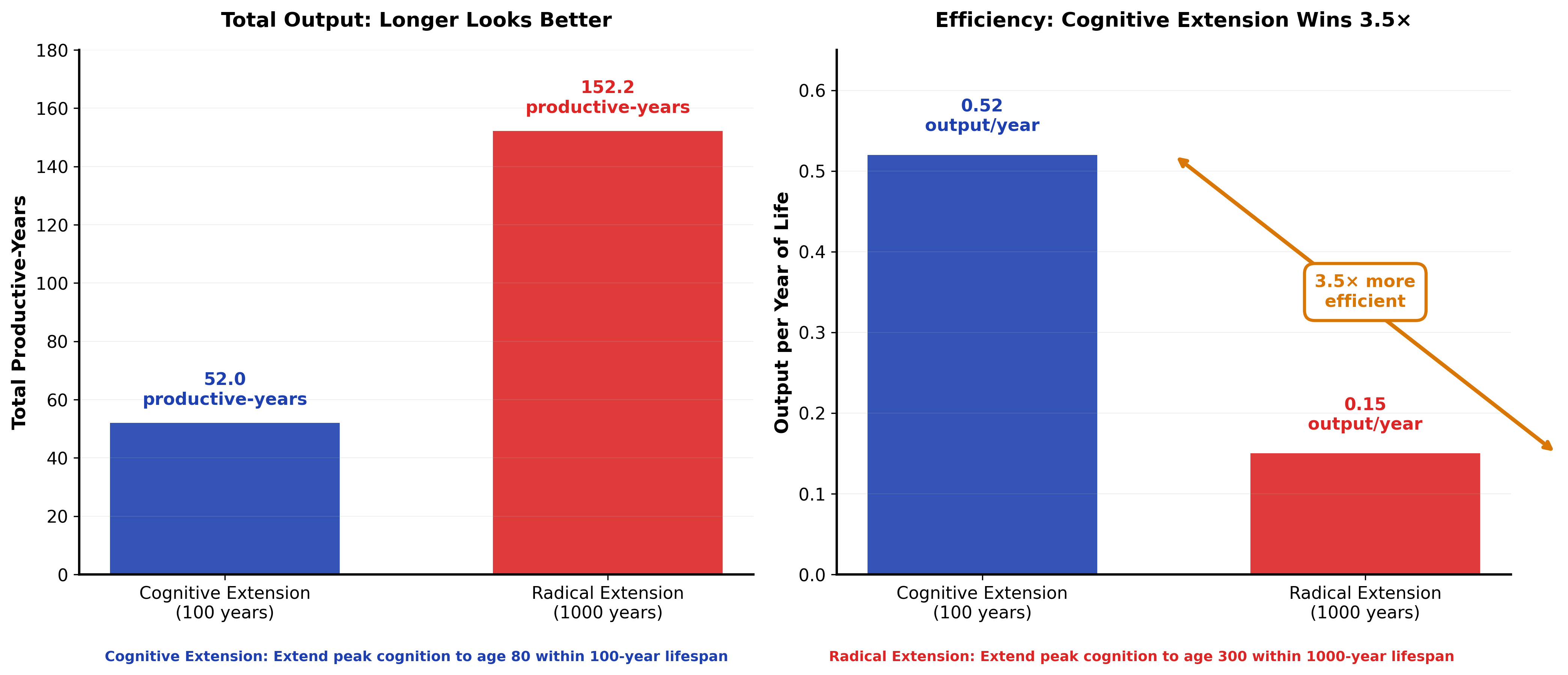
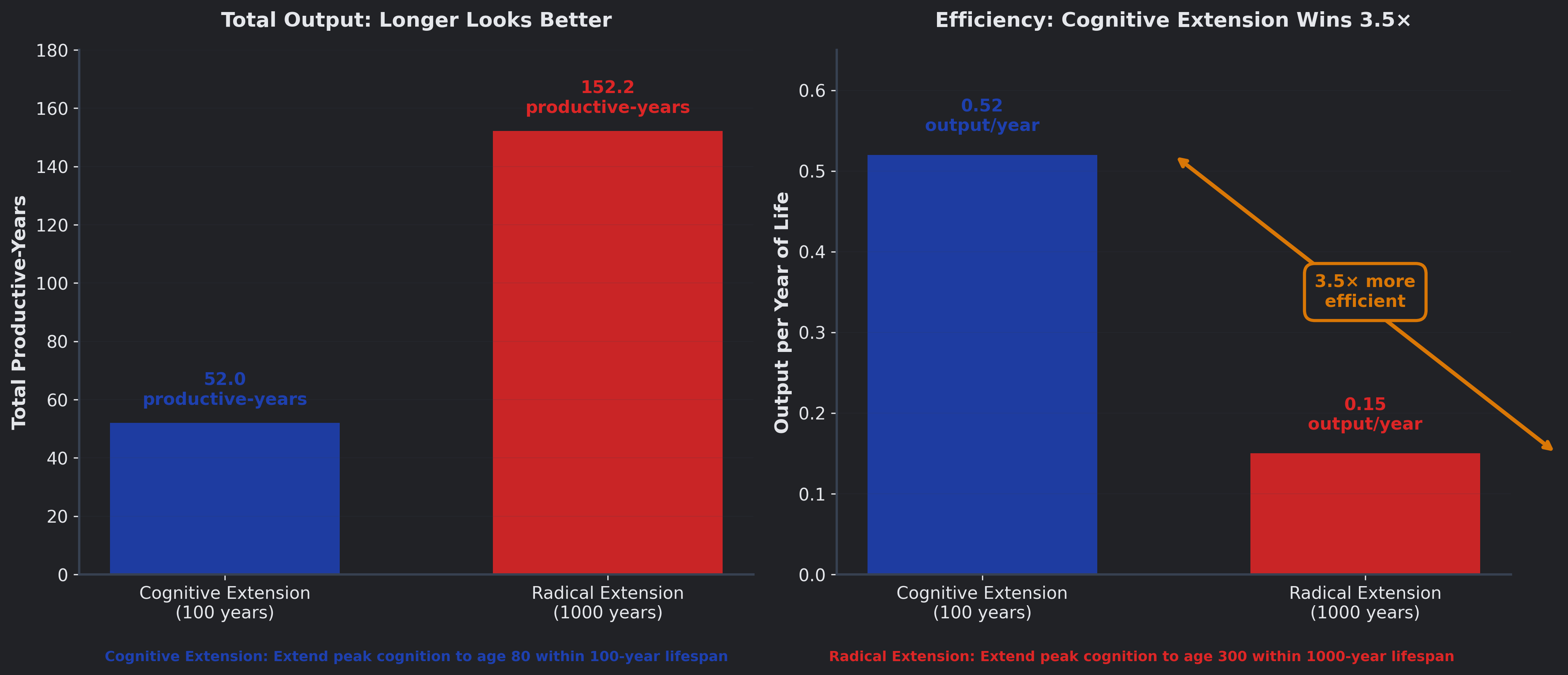
I believe the alternative is quite obvious: rather than drastically extending our lifespan, extend cognative peak within roughly normal lifespans. Extending cognitive peak to age 80 within a 100-year lifespan produces about 52 productive years of output, or 0.52 output per year of life. Extending lifespan to 1000 years with cognitive peak to age 300 produces 152 productive years, sounds better, but that’s only 0.15 output per year. The former is 3.5x more efficient at generating human value.
Cognitive extension vs radical life extension
There’s something quite poetic about this. The obsession with living longer, our quintessential measure of medical progress, may actually hinder us in the long run. Every time I walk to my office, I’m making a bet. With 61 years left, I’ll take that bet. With 980, I’m not so sure. And when enough people stop taking enough bets, civilization stagnates.
The goal shouldn’t be more years, it should be more productive years. Quality over quantity if you will.
All my projections extend wayyyy beyond biological plausibility - we have emperical data to age ~85 and extrapolating to 500-1000 years require assumptions that may not hold. Nonetheless, the societal implications remain dire.
Enter your email to receive the occasional update.